
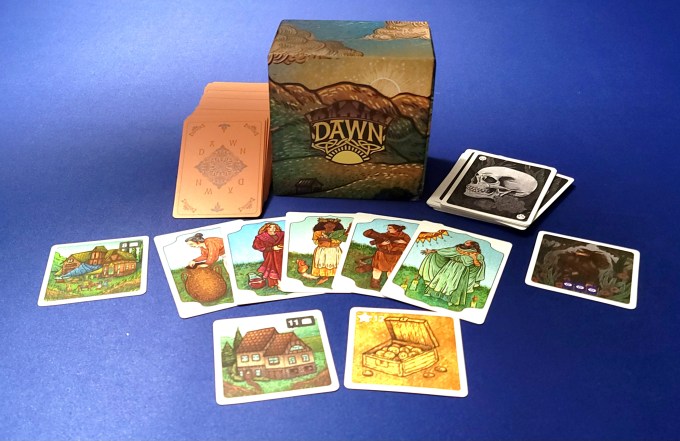
In Dawn, a newly released card game sent to us for review by Green Meadow games, players secretly choose if they want to be an ally, helping their team towards a shared victory building a village or a scoundrel, helping themselves to treasure. It is not revealed until the end of the game whose side each player is on.

In two sentences, what do you do in the game: The game plays over six rounds, where players play their cards facedown to either help or hurt shared goals to claim buildings and vanquish threats revealed that round. At end-game players reveal roles and if the players successfully built the village.
Have we played any other titles by this publisher?: No, this is the first game we have played by Green Meadow Games.
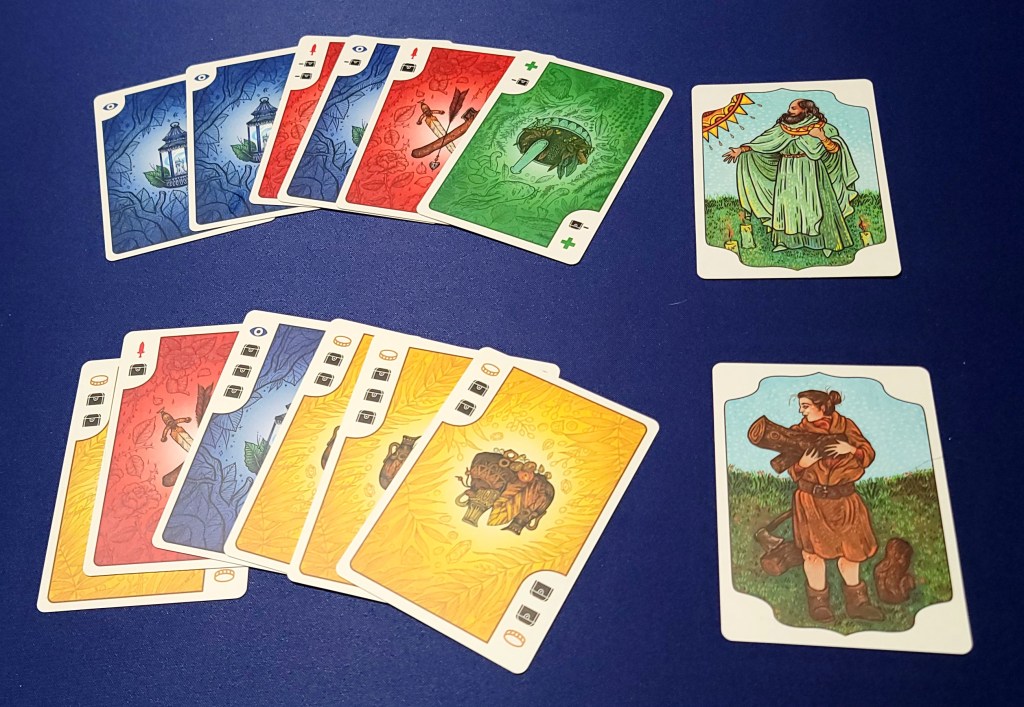
What was surprising about this title: The wound card mechanic was surprising, each time a wound card is gained, it limits the amount of cards one can draw in the next round, so it is important to get rid of wounds as quickly as possible.

How likely is this to return to the game table?: Not as likely for us. We appreciate this game and the idea behind it but found the gameplay unbalanced. There was difficulty at least in the two player game to amass the right amount of cards to heal wounds, gain building cards, and vanquish threats. Threats are maybe the easiest to get rid of, but there are often too many of them to focus ones efforts effectively on all the game’s goals. For example, for every wound we would get rid of with three cards (healing and/or wild cards), we’d be missing out on gaining buildings cards or vanquishing threats (which often cause wounds) because of how few cards we had to spend or the high price to meet the card requirements for buildings or threats.
Game length: The game is fairly short, it advertises a 45 minute game time, but we found that sometimes that was shorter for us as two players as we could take our actions fairly quickly.
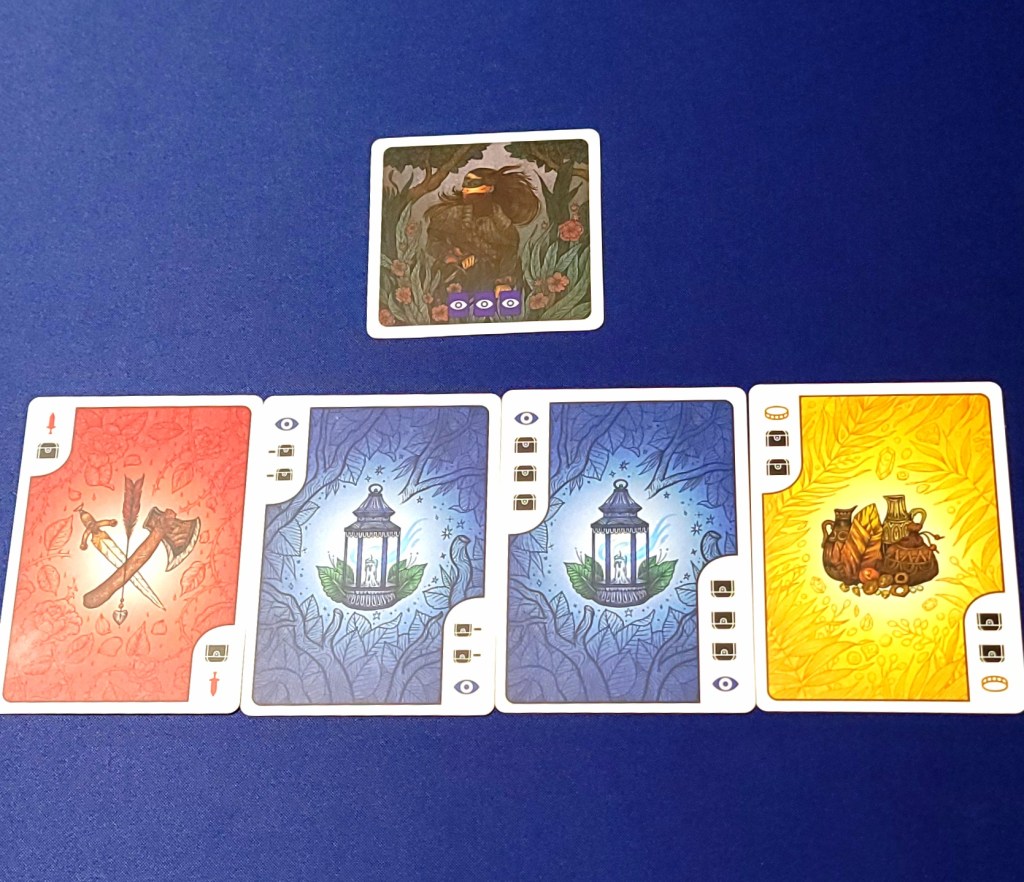
Language Barrier Playability: Good once you know the rules. The cards themselves mostly rely on symbols, besides the affects of an unvanquished threat which require a little reading. Players would also need to memorize the resource cards but there are only four types of resource cards.
Artwork: The artwork is gorgeous. There is a nice consistency in the artwork in a colorfully drawn style depicting ancient northern European themes. The textures of the drawings are brought to life by the excellent linework throughout the cards and box design.

Quality: We found that the cards stick together a little, but the quality is good otherwise. This game consists exclusively of cards, some secret objective envelopes, and a wooden First Player Token, which is sturdy and painted very neatly.

Strategy: Strategy can be difficult in this game due to the balance issues we found. The game does have a lot of areas where strategy is encouraged. For one, when players are choosing what type of win they are going for, they need to be conscientious of how many treasure icons are in their storehouse, because if they have more than seven treasure icons they can only win as a scoundrel/if the team fails to meet their goals. The individual player storehouse consists of a set-aside card pile, which players contribute one card to each round. They can switch out this card one-for-one at any time with cards from their hand, so this can be part of any player’s strategy while playing as well.
Another area of strategizing for both scoundrels and allies have to do with what card piles they decide to contribute to, Players can add cards facedown under buildings and threats in play that round to either help the team or hurt the team, but they only have a certain amount of cards, so it is important to strategize where they would be most useful. Players also have to strategize to get rid of their wound cards by saving three Healing and/or wild cards to get rid of a wound, and this can take a lot of cards away from other goals. Wild cards are definitely very useful throughout the game as there are a lot of them.
Instruction Manual: The instruction manual had some areas for improvement for us in regard to clarification and consistency. We were able to get the overall idea from the rulebook, but there are some things missing or inconsistent we had to work through. Tile cards are sometimes called Building Tiles and sometimes Town Tiles so it can be a bit confusing figuring out they mean the same thing on your first read through.
Organization: The box fits all of the cards well and has a nice ribbon tab to open the box. A divider for the card types might be useful, but it works as is just fine. Even without a divider, the cards are easy to put away and easy to remove.
Final thoughts: We see potential in the idea that drives Dawn. We liked that players could choose what side they were on and work towards their goals secretly, however getting to those goals was difficult with card limitations and high card requirements. It is not easy to build a village, however, and there is still a lot to be appreciated in the story and theme. This review is based on two players only and these balance issues may not be as debilitating with higher player counts. However, since the difficulty is scaled with players it may not be a factor.


 Sushiball Games
I’ve played Dawn many times with 3 or more and we had tons of fun with the game. It’s a little bit different each time.
There is a lot on conversation during the game and interesting to see who tries to be a scoundrel or changes near the end. I honestly haven’t played with 2.
I highly recommend this game for the artistry, mechanics, and play.
LikeLike
Yes, we really enjoyed the artistry and the scoundrel component the most! That is excellent to know that 3+ is a good player count for this, we were curious on that front. Thank you for sharing!
LikeLike