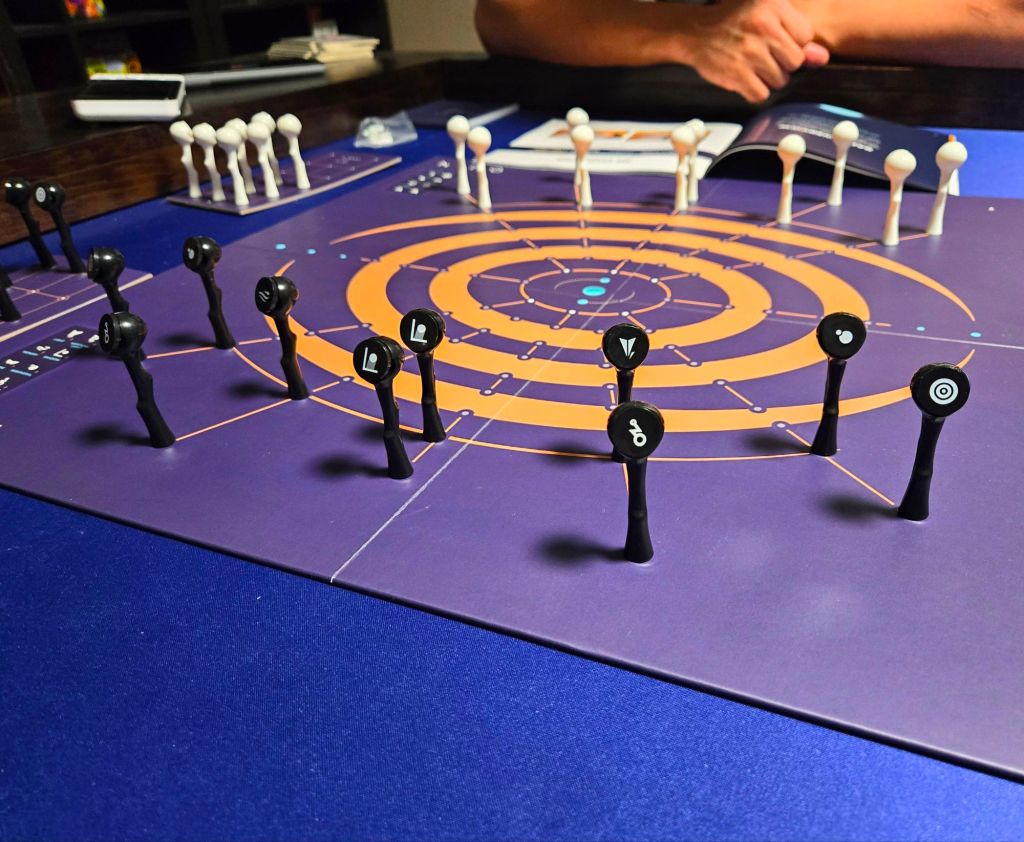
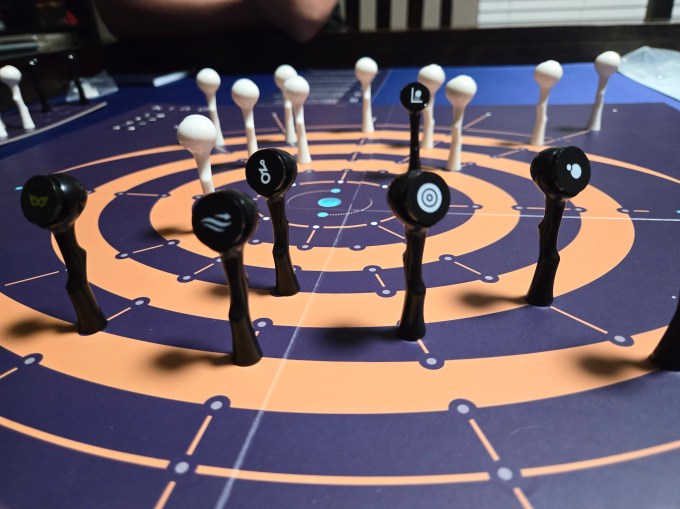
Try to outmaneuver your opponent in this chess-like quantum themed strategy game. You can keep your pieces hidden and reveal them only when attacking your opponent, leaving the game to be more mysterious and dependent on good memory or reveal all from the start.
Was this game sent for review or self-purchased?: Quin was sent to us for review. Quin is published by Arch & Gravity Publishing and designed by Taeleen Woodard and Brian Rooney.

In two sentences, what do you do in the game: You are trying to take your light to the center of the board called the iris or capture the opponent’s light. Your pieces are customized at the beginning of the game, and different pieces are brought in throughout, each type behaving uniquely from one another.
Have we played any other titles by this publisher?: We have not played any other titles by this publisher.

What was surprising about this title: The amount of strategy that goes into each game is extraordinary. Since all pieces are kept hidden from your opponent in arcade and third-eye mode, strategy is extremely important as revealing the wrong piece at the wrong time can significantly alter gameplay. If you can figure out where your opponent’s light is, you know when and where to attack. The game is also highly dependent on memory in these modes as you must also try to memorize where the opponents pieces are as you reveal them. You must also cautiously move and attack as it may reveal your pieces without benefit to you. It becomes a game of cautious attack and tactical defense. The game also has removable face pieces so that the opponent’s pieces as well as your own can be in full view in Vision mode. This completely changes the gameplay, as you can see what your opponent is up to every step of the way. This is our preferred way of playing as bluffing and deception can become overwhelming on top of other strategy when your pieces are hidden.

How likely is this to return to the game table?: Moderately likely. The game has a lot of customizability as well as various defense and offensive strategies, so much so that it has an even more complicated ruleset, which gives you even more abilities. The box includes a strategy guide for advanced gameplay. The game is more likely to hit our table with the game pieces in full view. We prefer to be able to see and outmaneuver pieces, rather than have to focus on memory and bluffing on top of it, which makes it a little overcomplicated for our preference.

Game length: Anywhere from 10-45 minutes on average. The game can end very quickly if you do not know what your opponent’s pieces are doing and if you’re good at bluffing. It becomes a somewhat lengthier game when the pieces are on full display, but even when you are able to incorporate more complicated strategies, the game still is relatively short at around 20-50 minutes. It’s a good game to play with your partner or a friend while you wait for additional people to play. It hits that sweet spot in length so it never feels like you’ll keep people waiting for a long time between games.
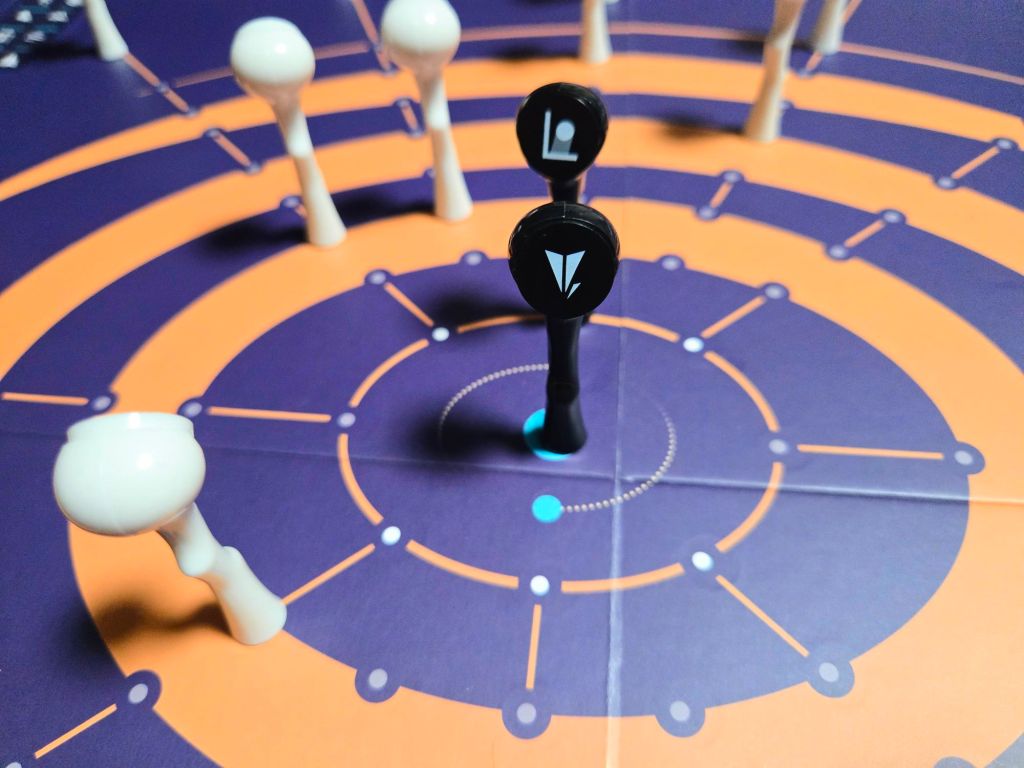
Language Barrier Playability: Excellent. All you need to do is explain how pieces move and how flashing and capturing work, but memorizing this all can take a little while. The game is entirely dependent on symbols and numbers, so verbal communication is very limited during play.

Artwork: Minimalist. This game looks strange and fantastic. The theme is quantum. We feel like it does a good job of illiciting atomic models and how energy levels “feel” as you play. It makes you feel like you’re playing something having to do with physics and chemistry without taking its theme too seriously.
Quality: Excellent. The game board and pieces are magnetic. This helps with the theme of quantum physics and it makes for a satisfying way to keep the pieces on the board. The magnets are strong without being difficult to remove and the game pieces are oddly shaped little tubes with a lump at the end. The pieces also have removable faces that are sturdy and easy to remove and replace without fear of breaking them.
Strategy: Heavy. This game is extremely strategic. There are many ways of playing with varying levels of strategic depth. You can play with the more simple basic rules or the “Third Eye Open” rules, which give pieces more abilities and change the rules just enough to make the game feel different. These two rulesets can be played with your pieces hidden from your opponent or with your pieces out in the open, making everything visible to everyone. Both are enjoyable methods of play, but we preferred playing with pieces revealed at all times, especially at the beginning of our Quin journey.
Instruction Manual: Detailed but complicated. The manual includes in- depth descriptions of how each piece moves as well as tips and tricks on how to play. The game also has a quick start guide as well as an in-depth strategy guide for when you’ve played a few games and want to step up your maneuvers. There is a lot to memorize, and we found ourselves using the quick start guide often.
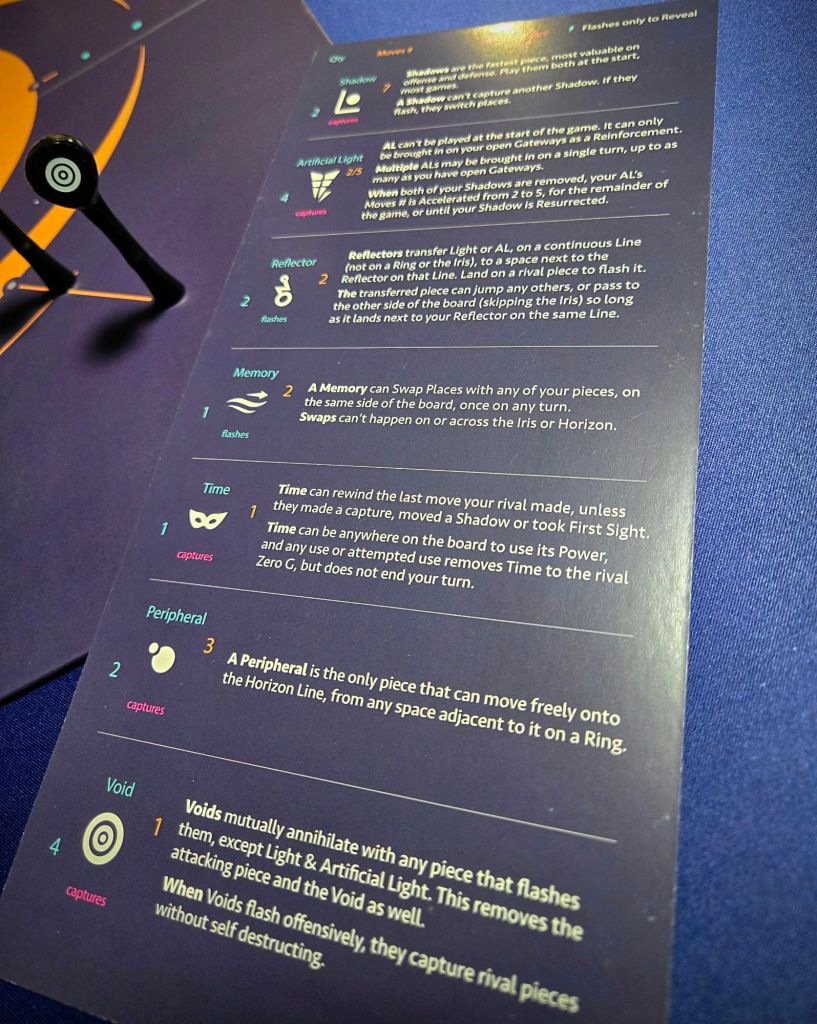
Organization: Excellent. The game fits neatly into the box with room to spare. The pieces also have cloth bags that cinch closed, and it comes with a set of coasters for drinks. While the coasters are meant to hold a cup of water to determine who plays first (the first person to drink their cup first begins the game), we used the coasters as our totems. A totem is used to “revive” a fallen piece once per game and is supposed to be something that is meaningful to you, like a doll or a figurine, etc. If a piece is destroyed, you flip your totem to signify you used it up. Since the game contains 2 coasters, we used the coasters as totems and flipping them over shows they have been used up.

Final thoughts: Quin is a fun, abstract strategy game that can be played as a chess-like quantum themed game or as a bluffing chess-like strategy game. The game is complicated and it is a very strategic experience that is enjoyable. Quin has a unique aesthetic and is one of the few games where the abstract theme works well. Oftentimes, abstract themes end up with odd choices that deter from gameplay but Quin pairs the realm of quantum mechanics (which is already confusing on its own) with a fun atomic themed board and light-based pieces. Quin is a fun intersection between chess and stratego with a high emphasis on customization and asymmetrical combat.